



If you've ever pulled a tray of cookies from the oven and wondered if there's a better way to sweeten them… you're not alone.
Maybe you're trying to support healthier blood sugar levels. Maybe you're reading ingredient labels more carefully than you used to. Or maybe you simply don't love the idea of relying so heavily on refined white sugar in your everyday baking.
You might want more flavor. More nourishment. More intention.
But if you've ever tried swapping sugar for honey, maple syrup, or a zero-calorie sweetener and ended up with flat cookies or dense muffins, you also might have discovered that simply swapping sugar in a recipe does not always work. Because here's the thing: not all sweeteners behave the same way.
Successfully baking with sugar alternatives isn't about random substitution. It's about understanding what sugar actually does in a recipe and choosing replacements that support texture, moisture, browning, and flavor.
Let's discover how you can use sugar alternatives for baking so your cookies turn out like they're meant to!
You can learn more about these natural sweeteners with their pros and cons here!
what sugar really does in baking
Before you swap it out, remember that sugar is a multitasker. It provides:
- Sweetness: The obvious one we're all after ;-)
- Moisture Retention: Sugar is hygroscopic, meaning it absorbs and retains water, keeping your bread soft and your cookies chewy.
- Tenderness: Sugar interferes with gluten development, which is why sugary cakes are "tender" rather than "bready."
- Browning: Through the Maillard reaction and caramelization, sugar creates that golden-brown crust that we all love.
- Leavening: When "creamed" with butter, sugar crystals carve tiny air pockets into the fat, helping the cake rise.
If you remove sugar without adjusting other ingredients, you may end up with dry muffins, flat cookies, or pale cakes. The goal isn't just sweetness but also balance.
It's important to remember that not all sugar alternatives are equal. Some are liquid or extremely concentrated. Some promote browning while others do not. Some add moisture and density, while others contribute sweetness alone.
So you want to choose sugar alternatives that support both the recipe's structure and the goals you have in mind.
9 sugar alternatives for baking
liquid sweeteners
Liquid sweeteners add moisture, so you must reduce other liquids (like milk or water) in the recipe to maintain the right consistency.
1. Honey
- Flavor: Floral and rich.
- Sweetness: Sweeter than white sugar.
- The Swap: ¾ cup honey for every 1 cup sugar.
- The Adjustment: Reduce other liquids by 2–3 tablespoons. Lower oven temperature by 25°F (honey caramelizes/burns faster than sugar).
- Pro Tip: Add a pinch of baking soda to neutralize honey's natural acidity and help with rising.
- Best for: Muffins, quick breads, granola bars, softer cookies.
Honey adds beautiful browning and depth, but using too much can make baked goods overly moist or dense.
2. Maple Syrup
- Flavor: Mild caramel, slightly earthy.
- The Swap: ¾ cup maple syrup per 1 cup sugar.
- The Adjustment: Reduce liquids by 3 tablespoons.
- Best For: Pancakes, muffins, and oatmeal cookies.
Maple syrup adds subtle flavor and moisture without overwhelming most recipes.
Agave Nectar
- Flavor: Neutral
- Sweetness: 1.4 times sweeter than sugar
- The Swap: About ⅔ to ¾ cup per 1 cup sugar.
- The Adjustment: Reduce other liquids slightly.
- Best For: Soft cookies, muffins and quick breads, granola bars, brownies
Agave blends well into recipes where you want sweetness without strong flavor. It’s less ideal for recipes that rely on sugar for structure or crispness, like crunchy cookies. Keep in mind it is high in fructose, so moderation still matters.
3. Molasses
- Flavor: Deep, robust, slightly bitter.
- The Swap: Do not replace 100%. Use as a partial replacement (up to ½ cup).
- The Adjustment: Reduce other liquids by 2–3 tablespoons.
- Best For: Gingerbread, spice cakes, rye breads. It adds significant moisture and a heavy crumb.
Molasses adds minerals and rich color but can overpower delicate recipes.
4. Barley Malt Syrup
- Flavor: Toasted, malty
- Sweetness: Less sweet than sugar
- The Swap: For 1 cup sugar, use 1 to 1¼ cups barley malt syrup
- The Adjustment: Reduce other liquids by 3–4 tablespoons per cup used.
- Best For: Whole-grain breads and rustic baked goods.
Barley malt syrup enhances browning and adds a subtle complexity, but is rarely used as a full sugar replacement. It’s not ideal for light, delicate cakes because it adds density and a distinct malty flavor.
high-intensity sweeteners
These are excellent for blood sugar management but lack "bulk."
5. Stevia
- Sweetness: 200–300 times sweeter than sugar
- The Swap: ¼–½ tsp. to replace 1 cup sugar.
- The Adjustment: Add a bulking ingredient (like applesauce, yogurt, or a sugar-alternative baking blend) to maintain structure and moisture.
- Pro Tip: Replace only 25–50% of the sugar.
- Best for: Quick breads, muffins, smoothies, or recipes specifically developed for low-sugar baking.
Stevia provides no bulk or structure. That means baked goods may turn out dense, dry, pale, or lacking caramelization.
BUY ORGANIC STEVIA EXTRACT POWDER
6. Xylitol
- Sweetness: Equal to sugar
- The Swap: Use 1 cup xylitol for 1 cup sugar.
- The Adjustment: No liquid adjustments needed. Browning may be lighter, and caramelization differs from sugar.
- Pro Tip: Xylitol is toxic to dogs and can cause digestive upset if consumed in large amounts.
- Best for: Cookies, cakes, muffins, everyday baking requiring 1:1 replacement
7. Monk Fruit
- Sweetness: Pure extract is extremely concentrated and sweet.
- The Swap: If using a monk fruit baking blend, substitute 1:1. If using pure extract, follow the product’s conversion guide carefully.
- Pro Tip: Choose a monk fruit baking blend rather than pure extract for the most reliable results.
- Best for: Cookies, cakes, and muffins when using a 1:1 baking blend; lower-glycemic baking recipes
Pure monk fruit does not provide bulk or browning, so recipes may require additional dry ingredients or structural adjustments unless using a baking blend.
fruit-based substitutes
8. Applesauce
- Flavor: Mild apple flavor, usually subtle in baked goods.
- Sweetness: Less sweet than sugar.
- The Swap: Replace up to ½–1 cup sugar with ½–1 cup unsweetened applesauce (best results when replacing only half the sugar).
- The Adjustment: Reduce other liquids by about 2–4 tablespoons if replacing a full cup.
- Best For: Muffins, snack cakes, quick breads, brownies, and kid-friendly baked goods.
Expect a softer, denser texture since applesauce adds moisture but no structure or caramelization.
9. Mashed Bananas
- Flavor: Sweet with a distinct banana flavor.
- Sweetness: Less sweet than sugar (but riper bananas are sweeter)
- The Swap: 1 cup mashed ripe banana for 1 cup sugar (replace only half the sugar for better texture).
- The Adjustment: Reduce other liquids by 2–4 tablespoons.
- Best For: Banana bread, muffins, pancakes, snack cakes, and hearty breakfast bakes.
Bananas add moisture and density, so baked goods will be softer and heavier.
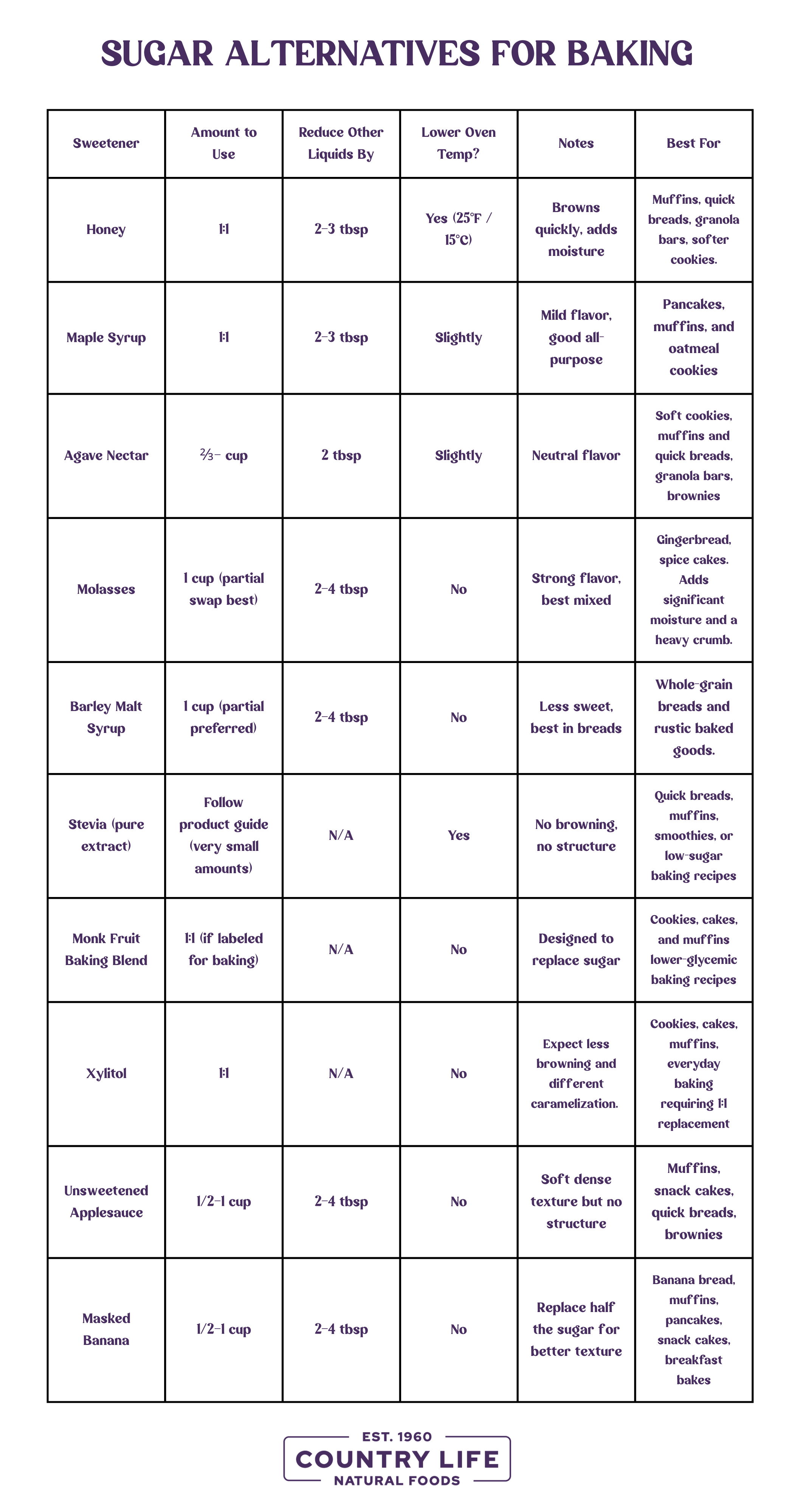
TIPS FOR CHOOSING THE RIGHT SUGAR ALTERNATIVE FOR BAKING
Sugar Substitution Conversion Chart
frequently asked questions
Can I substitute honey for sugar 1:1?
Not exactly. Use ¾ cup honey for 1 cup sugar and reduce other liquids by 2–3 tablespoons. You may also need to lower the oven temperature slightly since honey browns more quickly.
Why did my baked goods turn out dense with stevia?
Sugar provides structure, moisture retention, and browning. Stevia only provides sweetness. Without bulk, baked goods can turn out dry, dense, or pale unless the recipe is specifically designed for it.
Is agave healthier than sugar?
Agave has a lower glycemic index than white sugar, but it is high in fructose. Like all sweeteners, it's best used thoughtfully and in moderation.
Can I replace all the sugar in a recipe?
Sometimes — but expect changes in texture, moisture, and structure. Full replacements work best when using recipes specifically developed for that sweetener. In many cases, partial substitutions provide better results.
Which sugar substitute works best in cookies?
Cookies rely heavily on sugar for structure, spread, and crispness. Honey or maple syrup can work, but they will produce softer, more cake-like cookies unless the recipe is adjusted. For best results, start with a 50/50 blend of sugar and an alternative sweetener.
Monk fruit baking blends (labeled 1:1 for sugar replacement) can also work well in cookies when used as directed on the package.
Which sugar substitute works best for cakes?
Cakes depend on sugar for tenderness and volume. Maple syrup and honey are often the most reliable liquid substitutes when used with proper adjustments to reduce other liquids.
For lighter, fluffier cakes, partial substitution is usually more successful than a full replacement.
Can I bake with monk fruit alone?
Pure monk fruit extract is extremely concentrated and does not provide bulk or browning. It typically needs to be combined with other ingredients to replace sugar's structure.
However, monk fruit baking blends are specifically formulated to replace sugar 1:1 and are the easiest way to bake with monk fruit successfully.
Which sweetener browns best?
Honey and molasses promote strong browning and a deeper caramelized flavor.
Will maple syrup make my recipe taste like maple?
Slightly — but usually subtly, unless used in large amounts.
What's the most "natural" sugar substitute?
"Natural" can mean different things. Honey and maple syrup are minimally processed and close to their original source. Molasses is a byproduct of sugar production but retains minerals. Fruit purées like applesauce are simply whole foods blended.
The most natural option often depends on your definition — minimal processing, whole-food origin, or blood sugar impact.


